Elevate Your Ecommerce Business with These Top Marketing Strategies

The COVID-19 pandemic has had a significant impact on the ecommerce industry, with many people turning to online shopping as a result of lockdowns, quarantines, and social distancing measures. Because of the pandemic, There has been a sharp increase in demand for ecommerce. With physical stores closed or operating at reduced capacity, many people turned to online shopping as a way to purchase essential and non-essential goods. This resulted in a forced change of consumer behavior and shopping habits. The pandemic led to an accelerated adoption of shopping habits, with more people now preferring to shop online even after restrictions are lifted.

With strengthening of supply chains, concepts like Instant Commerce took roots. Some ecommerce sectors, such as groceries, home goods and online pharmacies have seen a particularly strong growth through this. In response to the increased demand for online shopping, many businesses and venture capitalists have invested in their ecommerce infrastructure, including their websites, mobile apps, fulfillment systems and delivery personnel.

Additionally, some other supportive factors for this growth include :

  1. Increased internet and mobile penetration: The widespread availability of the internet and the increasing use of mobile devices have made it easier for people to shop online.
  2. Improved payment systems: The development of secure online payment systems, especially UPI, and deeper penetration of credit and debit cards, has made it easier and more secure for people to make purchases online.
  3. Greater selection: Online retailers often offer a wider selection of products than brick-and-mortar stores, which can be a major attraction for shoppers.
  4. Competitive prices: Online retailers can often offer lower prices due to lower overhead costs, such as rent and utilities.
  5. Personalization: Ecommerce companies can use data about customers’ browsing and purchasing history to personalize their shopping experience and recommend products.

Before diving into the best Ecommerce digital marketing strategies, let us take a look at different types of Ecommerce businesses:

  1. Business-to-consumer (B2C) ecommerce: These businesses sell products or services directly to consumers through an online platform. Example : Ikea.
  2. Business-to-business (B2B) ecommerce: These businesses sell products or services to other businesses through an online platform. Example : Software as a Service companies like Zoho.
  3. Consumer-to-consumer (C2C) ecommerce: These allow individuals to sell products or services to other consumers through an online platform. Example : OLX.
  4. Consumer-to-business (C2B) ecommerce: These allow individuals to sell products or services to businesses through an online platform. Example : Fiverr.com

If you are in charge of promoting an ecommerce brand, the growth of the market seems bright. At the same time however, because of steep competition, there is a need to offer a differentiated solution for your customer and engage in a mixture of conventional and unconventional ecommerce marketing strategies. Here is some ground work you need to do before diving into the marketing strategies:

  1. Research if there is really a demand for your offering : The reason behind the failure of a lot of failed ecommerce businesses is very simple. There just isn’t enough demand for the offering in the market. Through primary and secondary research, make sure that your potential customers are willing to pay for your offering. This exercise of a few weeks will help you save on hundreds of thousands of dollars and several years of effort and frustration.
  2. Build a strong product differentiator : Simon Sinek says, “People don’t buy what you do, they buy why you do it.” Therefore, having a clear differentiator about your offering and how it will positively impact the lives of your customers, vital.
  3. Understand your target audience : It’s important to have a clear understanding of who your customers are, what they are interested in, and what motivates them to make a purchase. This will help you create targeted marketing campaigns that are more likely to be successful.
  4. Create a strong online presence : This includes having a well-designed website that is easy to navigate and use, perhaps a mobile app, or presence on social media platforms and other online channels where your target audience is active.
  5. Offer a seamless customer experience : This includes making it easy for customers to find and purchase products, providing clear and accurate product information, and offering excellent customer service. An Elevated Digital Experience at every touchpoint for your customer is the key.
  6. Use data and analytics : Collecting and analyzing data about your customers and their behavior can help you better understand their needs and preferences, and allow you to tailor your marketing efforts accordingly.

Now that the foundation for marketing has been laid, let us look at some conventional ecommerce digital marketing strategies which will give you results in 2023 :

  1. Search Engine Optimization : Use search engine optimization (SEO) or app store optimization (ASO) to improve your website’s visibility in search results. SEO or ASO is still here. Users will prefer organic ranking and love the process of discovering platforms on their own.
  2. Paid advertising : Utilize paid search advertising, such as Google Ads and Facebook Ads, to target specific keywords and drive traffic to your site. This still remains the fastest means of promotion digitally.
  3. Social Media Marketing : The platforms may change, but the need to engage in a community is here to stay. Use social media platforms to promote your products and connect with your audience.
  4. Video Content : Create and distribute valuable, relevant video content to attract and retain customers. Video remains the most powerful form of content. Short videos between 1-2 mins are great for reels whereas longer videos are suitable for more DIY kind of offerings.
  5. Email Marketing : Every year, experts predict the death of email marketing, and every year, it seems to bounce back. Utilize email marketing to stay in touch with your customers and promote your products or services. Serious users open email, spend time on reading them and engage with them.
  6. Affiliate Marketing : Some ecommerce products are best sold through affiliate networks. Utilize affiliate marketing, where other websites promote your products in exchange for a commission.
  7. Ad Retargeting : Remember, the awareness-to-conversion funnel is painfully long. There are some schools of thought which say that an ad needs to make an average of 7 impressions before a potential customer even starts taking it seriously. Use retargeting ads to show ads to people who have visited your site but haven’t made a purchase.

Here are some unconventional ideas which you can build upon :

  1. Offer chatbot via Whatsapp : The penetration and trust that Whatsapp enjoys is second to none. Offer customer support via a powerful Whatsapp bot which not only resolves queries before the purchase but also helps customers make payments, track their orders and give feedback.
  2. Create a customer loyalty program : Offer rewards or incentives to customers who make multiple purchases or refer their friends to your site. There are several loyalty-program platforms available in the market which you can easily plug into your existing ecommerce setup.
  3. Offer a subscription service : You would be surprised to know that even seemingly unrelated ecommerce companies can be great candidates for a subscription service. Consider offering a subscription service where customers can receive regular deliveries of your products. This will shoot your LTV through the roof.
  4. Host a contest or giveaway : Contest marketing is a great way to generate engagement and word of mouth. Run a contest or giveaway to generate buzz and attract new customers to your site.
  5. Humanize touchpoints : Having a high cart dropout rate? Record a video which reassures users that the decision they are about to make is the right one. Another example of humanized touchpoint can be a video thanking the customer after the purchase. Seeing human faces makes customers feel valued, and therefore prefers sticking to the platform.
  6. Use personalized content : Create interactive content, such as quizzes or polls, to engage with your customers and gather valuable data about their preferences and interests. Furthermore, personalize your touchpoints by using technology.
  7. Offer personalized recommendations : Use customer data and machine learning algorithms to offer personalized product recommendations to individual customers.
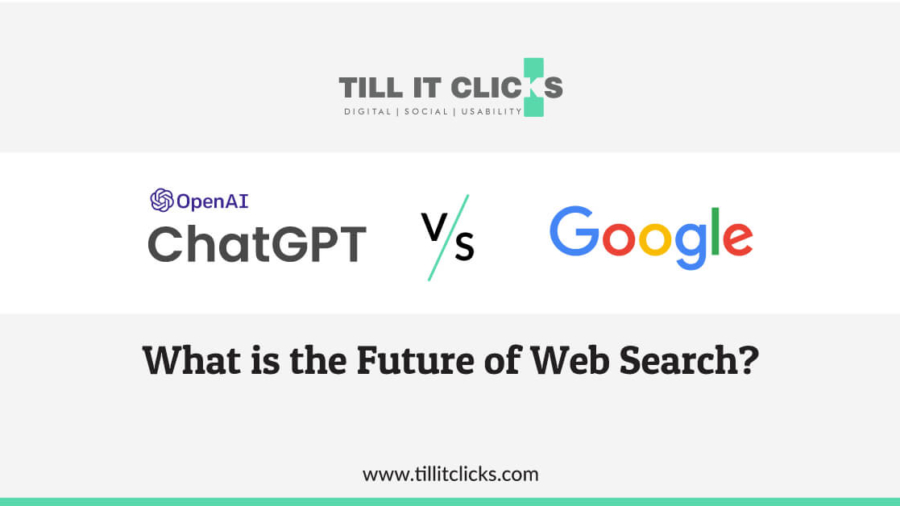
ChatGPT-Vs-Google--What-is-the-Future-of-Web-Search

ChatGPT Vs Google: What is the Future of Web Search?

“I have stopped using Google Search now”, said a friend. “I just go to ChatGPT and ask questions.” I was astonished.


It is possible that the technology behind ChatGPT or other similar language models could be used to improve natural language processing in search engines, but there are no specific plans for this at this time. It’s worth noting that Google already uses a number of AI technologies to improve its search results, including RankBrain, which helps understand the meaning of search queries, and predictive search, which provides suggestions as users type. These and other AI technologies are helping to make searches more accurate, relevant, and personalised.


The core utility of Google has been its ‘Search’ feature. With this feature, Google helps users find results which most likely contain the information that they are looking for. However, the innovation of ChatGPT looks quite promising and it may have eliminated the need for ‘Search’ entirely. With ChatGPT, you don’t need to ‘search’ for results; you straightaway get the answers to your questions. Most experts say that the answers are 95% to 98% accurate in the latest version of ChatGPT. Is that really true?


Will ‘Know’ really replace ‘Search’? We performed a small experiment to understand this. We provided a wide range of queries to both ChatGPT and Google Search and here are the output comparisons:

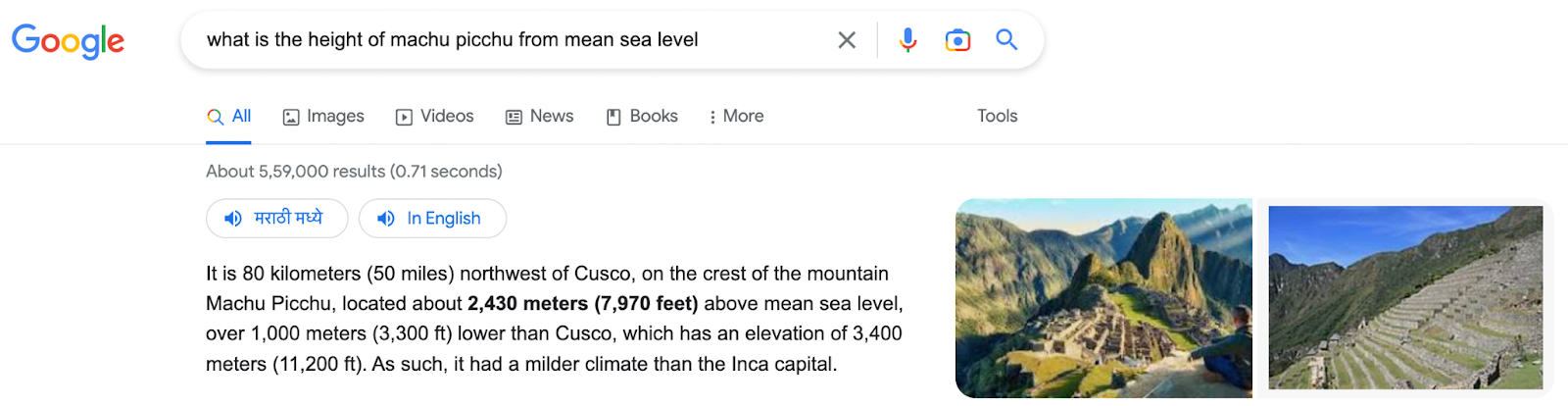
Query 1: What is the height of Machu Picchu from mean sea level?


Our Take: Although both results were accurate, Google Result was quicker and more concise than ChatGPT.


Google : 1 

ChatGPT : 0

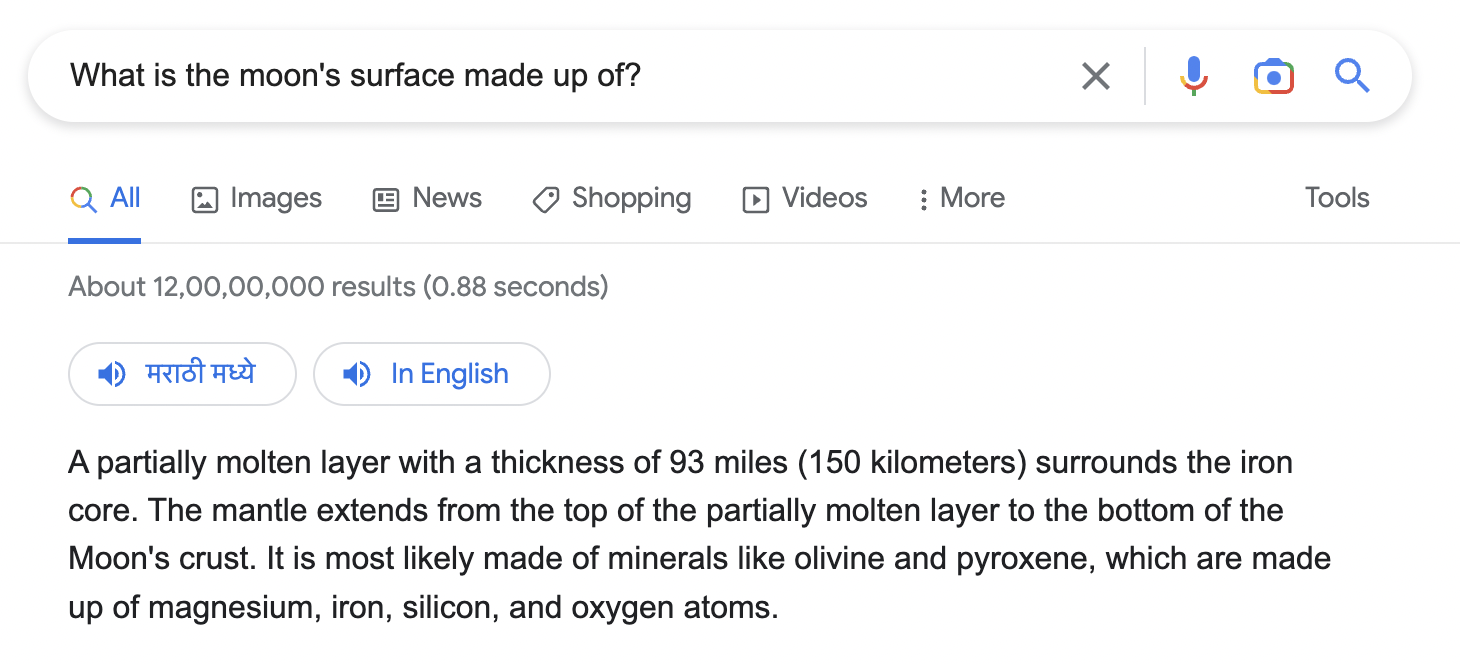
Query 2: What is the moon’s surface made up of?


Our Take: While we don’t know the scientific factuality of the answer, it looks like ChatGPT gave a more accurate result than Google.


Google : 1

ChatGPT:1

Query 3: How to make Gulab Jamun?


Our Take:

While Google provided search results, ChatGPT provided the actual recipe. This resulted in us having to spend less time finding the most accurate result.


Google : 1 

ChatGPT : 2


Query 4: How to get rid of pigeons?


Our Take: Google displayed ads first, and the actual answer came after the ad. ChatGPT, on the other hand, directly provided the answer. However, we feel that in terms of accuracy, there was no clear winner so we can give one point to both.


Google : 2

ChatGPT : 3


Query 5: HTML code for changing border-radius


Our Take: When it comes to asking for queries about technology, it looks like ChatGPT is a hands-down winner. It explains the code and also gives you the option to copy it for immediate use.


Google : 2

ChatGPT : 4

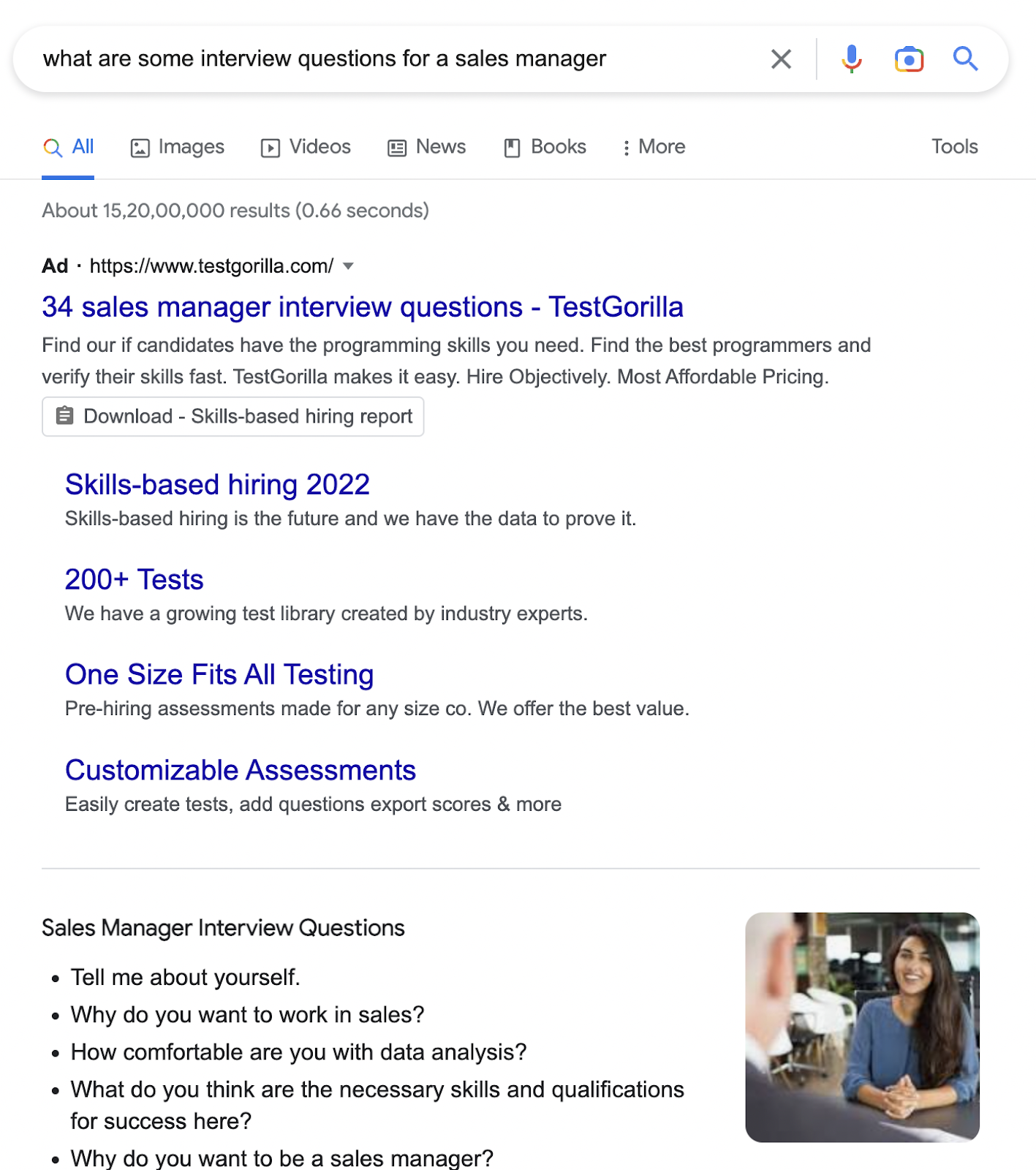
Query 6: What are some interview questions for a sales manager?


Our Take: Google and ChatGPT both displayed the answers. But while Google was busy serving ads and thereby truncating the answer, ChatGPT gave the full response. Moreover, when we look at the responses carefully, ChatGPT’s output seems to be more accurate.


Google : 2

ChatGPT : 5


ChatGPT – A Clear Winner


What does this mean? Will we move away from Google and start using ChatGPT for web searches? Will ChatGPT eat into Google’s pie of Search business? Will one surpass the other or can both of them co-exist? Only time will tell. One thing is for sure – finally, there is a technology that will give Google a run for its money.


What do you think? Let us know your thoughts


Hottest-Digital-Marketing-Trends-that-Brands-Must-Embrace-in-2023

Hottest Digital Marketing Trends that Brands Must Embrace in 2023

Digital Marketing Trends 2023

As 2023 dawns, the world is at an unsure place. While Crypto has seen a lot of ups and downs, there is almost no doubt that blockchain is here to stay. Although Metaverse was the talk of the town at the beginning of 2022, suddenly its buzz has quietened. Artificial Intelligence (AI), on the other hand, seems to be leveling up with the release of ChatGPT.

Digital marketing is on the cusp of revolution. The way forward for this industry is to latch onto the most influential and powerful trends. Here are some of these digital marketing trends that brands should look out for in 2023.

Personalisation

As consumers become more savvy and accustomed to personalized experiences, businesses will need to find ways to personalize their efforts in order to stand out. This also includes customising and personalising marketing communication to address the pain points of various groups of customers. The goal of personalisation is to create a more relevant experience for customers to increase engagement and build loyalty.

Personalisation in marketing can be achieved by curating the website experiences of target audiences depending on their location and other factors. Social media posts can also be used to target specific audiences by tailoring the posts based on demographics and interests of customers.

So, personalisation can be an effective way for businesses to improve customer experience, drive engagement and boost conversions. The use of AI can turn out to be a great option to deliver data-driven and targeted messaging and recommendations to customers.

Video content

Video content continues to grow in popularity and is likely to remain an important digital marketing trend for businesses. There are many benefits to using video content in digital marketing. For one, video is highly engaging and can capture the attention of viewers in a way that text and images may not.
Video content also has the potential to be more immersive and convey more information in a shorter amount of time than other types of content. It can be used in various formats in digital marketing, including short social media videos, live streams, product demos, explainer videos, customer testimonials, or traditional video advertisements.

Videos can be the preferred option of content consumption over text for some people. So, opting for a video format can help businesses reach out to a larger audience and potentially attract new customers. Video content is thus a powerful tool for digital marketing, helping businesses to engage and entertain audiences to drive conversions

Social Media & Influencer Marketing

Social media & influencer marketing has been one of the popular digital marketing trends that brands have been jumping on in recent years. In 2023 too, using social media platforms and partnering with influencers will continue to be the key strategy for businesses to connect with customers, build brand awareness, and drive sales.

With the widespread use of social media by people across the globe, the importance of social media is increasing in the digital marketing mix. As a result, brands are focusing more on communicating with their customers through social media platforms like Instagram, Twitter, LinkedIn and Facebook.

Thanks to its great reach and higher engagement, social media and influencer marketing is likely to keep growing as a viable option for brands to connect with their customers in a more personal and interactive way. This can include creating and sharing posts, running social media ads, and engaging with users through comments and messages.

Voice Search Optimization

With the increasing popularity of voice assistants like ‘Siri’ and ‘Alexa’, more and more people are using voice commands to search the web. As a result, businesses will need to optimise their websites and content for voice search in order to reach the right audience.

To optimize for voice search, businesses can go with the following strategies:

Overall, voice search optimisation is an important trend in digital marketing as the use of voice search continues to grow. By optimising for voice search, businesses can improve their visibility and reach in search results and better meet the needs of customers using voice assistants.

Customer Experience - Biggest Digital Marketing Trend to Capitalize On

Of all the digital marketing trends, focusing on customer experience is the most important one. With growing competition, businesses will need to provide a seamless and positive customer experience in order to stand out and retain customers. The use of AI and other technologies as well as chatbots can be beneficial in making customer journeys more seamless and enhancing their experience. This, in turn, can boost engagement and help brands witness better customer loyalty and higher conversions.

Digital marketing is a crucial aspect of any modern business. It allows you to reach and engage with your target audience online, through various channels such as social media, email, and search engines. By implementing a comprehensive digital marketing strategy, you can increase brand awareness, drive website traffic, and generate leads and sales. Our digital marketing services include search engine optimizationsocial media marketing, email marketing, and more, all designed to help you reach your business goals and grow your online presence. We have a team of experienced digital marketing experts ready to help you succeed in the digital world.


Do you know of any other digital marketing trends which marketers should watch out for in 2023? Let us know in the comments section.